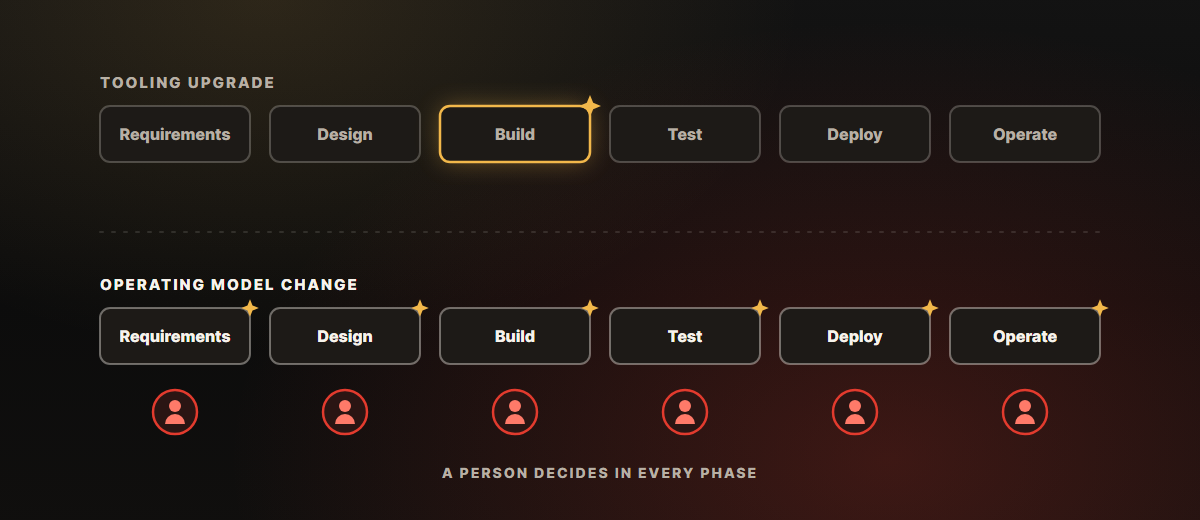
Most organizations I talk to describe their AI journey in terms of tools. They rolled out a coding assistant, turned on AI code review, and maybe ran a pilot with an agent that writes tests. Those are reasonable steps. But when people say they are moving to an AI-native software development life cycle (AN-SDLC), they usually mean more than that: a way of building software where AI agents do a large share of the work across the whole life cycle, and people direct, review, and decide.
That is not a tooling upgrade. It is a change to who does what, what "done" means, and where accountability sits. In other words, it is an operating model change, and it needs to be managed like one.
I come at this from two sides. I have built several projects end to end with an AI-native approach: agents writing the code, the tests, and most of the documentation, with me acting as product owner, architect, and reviewer. And I spend my working days delivering complex programs in large organizations, where the hard part is rarely the technology. What follows comes from putting those two experiences side by side.
The trap: faster typists in an unchanged process
The most common pattern is to keep the existing process and make one step faster. Developers write code faster. Everything around them stays the same: the same requirements quality, the same review process, the same testing approach, the same release gates.
The result is predictable. Work piles up in front of the steps that did not change. Reviewers drown. Testers find more defects, not fewer, because more code is arriving. Leaders see activity go up and lead time barely move, and conclude that AI is overhyped.
The tool worked. The operating model did not change around it.
What actually shifts
When I worked AI-native, four things changed more than I expected.
- The specification becomes the product. An agent builds exactly what you describe, including the gaps. Vague requirements that a senior developer would have quietly filled in with judgment get filled in with plausible guesses instead. On my projects, the time I spent writing clear intent, constraints, and acceptance criteria was the best-invested time of the whole effort. When I skipped it, I paid for it in rework.
- Review becomes the core engineering skill. When an agent can produce a working feature in minutes, the scarce skill is no longer writing code. It is reading code critically, spotting what is subtly wrong, and knowing when "it works" is not the same as "it is right."
- Tests become contracts. Automated tests used to be a safety net. In an AI-native flow, they are how you tell the agent what correct means, and how you know it did not break something else along the way.
- People approve rather than produce. The human role shifts toward deciding: what to build, which approach to accept, what is safe to release. That is a different job, and not everyone will want it or be good at it right away.
What does not change
It is just as important to be clear about what stays the same.
- Accountability. An agent cannot own a production incident. A named person still has to.
- Architecture. Agents are good at local decisions and weaker at the long-term shape of a system. The decisions that are expensive to reverse still need experienced people.
- Understanding the business. The hardest part of most projects was never typing the code. It was knowing what the business actually needs. That has not gotten easier.
What this means for delivery leaders
If AN-SDLC is an operating model change, it should be led like one. A few things I would do first:
- Start with one team and one real product, not a tools rollout across everyone. You are designing a new way of working, and you need a place to learn.
- Redefine "done" before you measure anything. Write down what a human must review, what must be tested automatically, and who approves a release.
- Measure flow, not output. Lines of code and pull requests per day will go up and tell you nothing. Watch lead time from idea to production, defects that escape to production, and rework.
- Invest in the skills that become scarce: writing clear specifications, reviewing critically, and designing good tests.
- Treat it as a change for people, not just process. Roles, identity, and incentives all move. That is where most of the resistance will come from, and where most of the leadership work is.
If you are already seeing that resistance, Why good people resist good changes covers the five reasons I see most often, and what helps with each one.
The question to ask
If you want to know whether your organization is really moving toward AI-native delivery, do not ask how many people have access to the tools. Ask:
"In each phase of our life cycle, who decides, and how do they know the work is right?"
If the answer is the same as it was two years ago, you have new tools and an old operating model.
AI can make the work faster. Only people can decide what the work should be.
Let's talk
If your teams are in the middle of moving to AI-native delivery and you want to think through the operating model, not just the tools, LinkedIn is the best place to reach me.
Want the next article? It is shared on LinkedIn and in the RSS feed.